PART TWO
Below are all the photos from Part Two of Deadliest Day


0.1: U.S. Army Air Assault Badge (AAB)
0.2: Combat Infantry Badge (CIB)

0.3: Camp Eagle


11.2: 501st Airborne Infantry Patch

11.3: Operations Map
11.1: Major General Ngo Quan Truong
Commander of the 1st ARVN Division

11.4: A flower pot. In the lower right corner of the photo is the entry way to the underground bunker that the flower pot was covering.

11.5: Cpt. Fry (L) and Lt. Judkins (R) are in the Booby Trap Ville company headquarters area.


11.7: South Vietnam flag with other insignia
11.6: Newspaper photo with caption "Courtesy of the Reds"
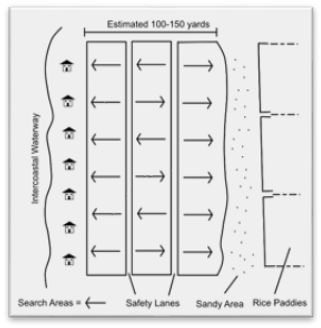
11.9: Company Plan

11.8: Col. John Hoefling, Lt. Col. John E. Rogers, Cpt. Fry, Lt. Gen. Richard G. Stilwell

12.1: Lady
Photo Gallery from Part Two

1.
2.
Picture 1. Disarming a booby-trapped mortar round that was exposed by an exploding Bangalore. This was one of 176 booby traps eliminated by the company during the operation.
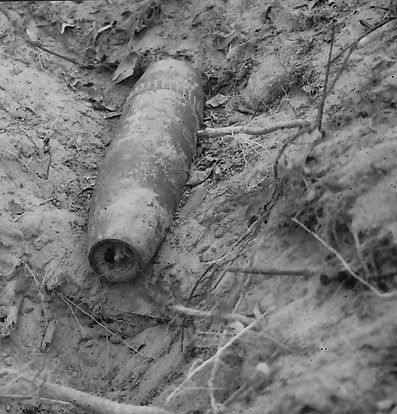
Picture 2. An unexploded American 105 howitzer round was the most feared booby trap found around Huế. It was not uncommon for one to take both legs of the man who tripped it and then kill or injure anyone within its “bursting radius” of around 50 yards. Such unexploded artillery rounds were not uncommon in sandy areas near fire support bases, which was the situation in the Eight-Klick Ville. When a 105 round was fired using minimum propellant, it was possible for the round to either not arm or to enter the sand at such an angle that it did not explode. The Vietcong then recovered these unexploded rounds, removed the fuse from the front, and converted them into booby traps.

3.
Picture 3. A picture of a small punji pit. By looking carefully, one can see the sharpened spikes sticking up from the ground inside the pit. In this picture, the ground litter has been scraped away. Before the Bangalore exposed it, there would have been a thin weaved mat over the pit with ground litter spread over it so it could not be seen.

4a.
4b.

Pictures 4a and 4b. The wooden box/frames in the pictures above were referred to as “flower pots” by the troops. The flower pots were filled with soil and camouflaged to blend in with the surrounding ground. The only things visible from above were two wire loops at ground level. One wire loop can be seen in the flower pot on the left. When the flower pot was filled with dirt and made to resemble the surrounding ground, it required someone who knew exactly where it was to grasp the two wires and lift the flower pot out of the tunnel entrance. Alpha Company first discovered the bunkers when the low pressure created by a Bangalore explosion popped a flower pot out of a tunnel entranceway. Once they saw the first flower pot lying next to a bunker entrance, they knew what to look for and found 111 more over the next week. The pictures also show the bunker entrance that the flower pots were hiding.
In sandy areas, some bunkers needed bamboo roofs and walls to hold the sand back. More than likely, a large bamboo container was constructed and then buried. In picture 4a, bamboo supports can be seen supporting the sides of the entrance way. The entranceways of the bunkers were also used as firing positions. The VC could stand in the entranceway and fire on his enemy, then drop into the bunker and pull the flower pot over the entranceway to hide himself and the bunker. He could also drop down into the bunker to protect himself from artillery fire and air strikes.

5a.
5b.

Pictures 5a and 5b. Brave infantrymen, commonly referred to as “tunnel rats,” enter the formerly hidden bunkers. Both carry a .45 caliber pistol and a flashlight. These bunkers were two of 112 found, searched, and destroyed.

6. Connecting the Bangalore Torpedo together.
Picture 6. Each Bangalore torpedo, which the troops referred to as just bangalores, measured 5 feet in length, had a diameter of 2.125 inches, and weighed 13 pounds. Both ends of the individual bangalore contained 4 inches of TNT booster, while the middle section contained 9 pounds of explosive material. One end of a single bangalore was attached to another, forming a chain of multiple bangalores. After a number of bangalores were attached together and pushed forward into the area to be cleared. Detonation cord was used to trigger the entire chain of bangalores. Alpha Company placed a wooden extension in front of the first bangalore to prevent an unseen booby trap from prematurely setting off the chain of bangalores. Bangalore torpedoes are also used to blow up barriers, clear large bunkers, and open lanes through barbed wire entanglements.

7.
Picture 7. The written descriptions of the Booby Trap Ville operation suggest that Alpha Company operated within the village. This photo demonstrates that they were not operating in a village. Instead, they were operating in the overgrown, brushy, scrub-wooded area between the village and the rice paddy fields to the west of the village, an area about 100 yards wide. The white cord hanging from the trees marks the trails that have been cleared and are safe to walk along.

8. Eight-Klick Ville, Vietnam, March 1969
Command Group, A/1/501 Airborne Infantry, 101st Airmobile Division
Picture 8. Company Command Group: Back row, left to right: the radio operator (RTO) monitoring the battalion radio net; the company commander, Cpt. Fry; the RTO on the company radio net, Jerry Salter; and the company senior medic, Roy “Doc” Gargus, who was later killed during the Battle of Tam Ky. Kneeling in the front (L to R): the artillery forwaPicture 8. Company Command Group: Back row, left to right: the radio operator (RTO) monitoring the battalion radio net; the company commander, Cpt. Fry; the RTO on the company radio net, Jerry Salter; and the company senior medic, Roy “Doc” Gargus, who was later killed during the Battle of Tam Ky. Kneeling in the front (L to R): the artillery forward observer’s RTO on the artillery radio net; the artillery forward observer. The three individuals not in combat gear are the field first sergeant (wearing glasses) and his two RTOs. They are preparing to receive a helicopter-delivered hot meal and will soon set up a chow line for the company, so they are not wearing their combat gear. The field first sergeant and his RTOs serve as backups for the company commander and his two RTOs in case any of them or their radios become disabled. They handle field logistics, including resupply and medevacs, which frees the company commander to concentrate on tactical operations without being distracted by logistical and administrative matters.rd observer’s RTO on the artillery radio net; the artillery forward observer. The three individuals not in combat gear are the field first sergeant (wearing glasses) and his two RTOs. They are preparing to receive a helicopter-delivered hot meal and will soon set up a chow line for the company, so they are not wearing their combat gear. The field first sergeant and his RTOs serve as backups for the company commander and his two RTOs in case any of them or their radios become disabled. They handle field logistics, including resupply and medevacs, which frees the company commander to concentrate on tactical operations without being distracted by logistical and administrative matters.

9.
Picture 9. Two of the finest platoon leaders to have served in Vietnam: Kneeling right is Lieutenant Larry G. Gottschalk, holding several captured rocket-propelled grenades (RPGs), and wearing captured linked machine gun ammunition over his shoulders. Larry later commanded Alpha Company. On the left is Lieutenant James C. Judkins Jr., holding an RPG and a captured carbine. Jim was later wounded during the Battle of Tam Ky and evacuated to the United States. He eventually retired from the Army as a Lieutenant Colonel. I am standing and holding a mortar round in my left hand and a Chinese Chicom grenade in my right.

10.
Picture 10. The man in the picture above was found inside the battalion cordon, where no civilians should have been. After reporting his capture, a Military Intelligence (MI) captain was sent to interrogate him. However, when the MI officer began attempting a form of “waterboarding” on the man, Cpt. Fry made him stop, resulting in a heated argument between the two captains. Ultimately, the MI captain returned to Camp Eagle with the man instead of interrogating him in the Alpha Company area.